

Why You May Still Be Afraid to Move After an Injury
And how a different approach to movement may help you rebuild confidence in your body.
Maybe you injured your back a few years ago.
Or perhaps it was your knee, shoulder, or hip.
You went through treatment, took time to recover, and eventually started feeling better.
But something hasn’t quite returned to normal.
You still hesitate before bending down to pick something up. You avoid certain exercises. Maybe you’ve stopped playing a sport, gardening, or doing activities you used to enjoy.
Not necessarily because you’re in pain.
But because you’re concerned about what might happen.
What if I hurt myself again? What if I make things worse?
If that sounds familiar, there’s something important worth understanding about how our bodies learn from movement.
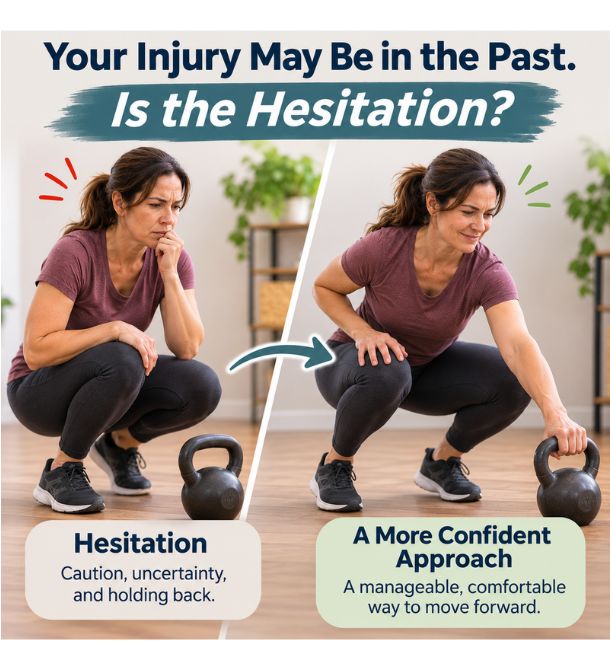
1. Your Body Can Remember an Unpleasant Movement Experience
Think back to when you first injured yourself.
Maybe you bent over and felt a sudden pain in your back. Or you twisted your knee during an activity.
That experience may have changed how you approached certain movements afterward.
And understandably so.
Pain and injury are important experiences. They help us recognize when something may require attention, protection, or time to recover.
But our brains also learn from those experiences.
A movement that was once associated with pain may continue to bring up caution or apprehension, even when the original injury has improved.
For example, you might find yourself hesitating before bending forward, lifting something, or returning to an exercise you used to do without thinking.
The movement itself may not be as risky as it once was, but your expectation of what might happen can still influence how you approach it.
Of course, not every injury heals completely, and some movements genuinely require continued precautions.
But when appropriate healing has occurred, lingering hesitation doesn’t always mean the body is incapable of performing the activity.
Sometimes, confidence simply hasn’t caught up with recovery.
2. How We Approach Movement After an Injury Matters
Imagine someone who previously injured their back and is now trying to return to exercise.
They decide to do a few squats.
But as they begin, they’re worried about aggravating their back.
They may approach the exercise very cautiously, rush through it to get it over with, or push themselves to complete a certain number of repetitions because they believe that’s what they’re supposed to do.
If the experience feels uncomfortable or frightening, they may become even less interested in repeating it.
Now imagine approaching that same exercise differently.
Instead of worrying about completing a full set, they begin with a version of the movement that’s appropriate for their current ability.
Maybe they use a chair for support, reduce the depth, or move at a more comfortable pace.
They pay attention to how they’re responding and adjust as needed.
The exercise hasn’t necessarily changed very much.
But the experience of doing it may be quite different.
And that difference can be important when rebuilding confidence.
3. Avoiding Movement Can Sometimes Keep Us Stuck
Avoiding certain activities after an injury can be appropriate, especially during the early stages of recovery.
But what happens when that avoidance continues long after the activity could safely be reintroduced?
You may gradually become less active.
Movements that used to feel familiar can begin to feel unfamiliar or intimidating.
And because you’re doing less, you may lose some of the strength, endurance, or physical conditioning that previously made those activities easier.
This can create a frustrating cycle.
You avoid an activity because you’re worried about how your body will respond.
But because you’re avoiding it, you have fewer opportunities to rebuild the physical ability and confidence needed to do it again.
The answer isn’t to ignore your concerns or force yourself through pain.
It’s to find appropriate ways to gradually return to movement.
And sometimes, that starts with changing how you approach the activity rather than immediately trying to do more.
4. Rebuilding Confidence Through Better Movement Experiences
One of the most valuable things you can do after an injury is begin having movement experiences that help you regain trust in your physical abilities.
That doesn’t mean every movement has to feel easy.
And it certainly doesn’t mean you should avoid all physical effort or discomfort.
Building strength, mobility, and endurance requires appropriate challenges.
But those challenges should match your current abilities and stage of recovery.
For example, if you’re hesitant about bending down, you might begin by exploring a smaller, more manageable version of the movement.
As your confidence and physical capacity improve, you can gradually increase the challenge.
The same principle can apply to squatting, lifting, walking, reaching overhead, or returning to exercise.
Rather than asking yourself, “Can I push through this?”
You might begin asking:
- Is this movement appropriate for where I am in my recovery?
- Could I adjust the range, pace, or difficulty?
- How does my body respond during and after the activity?
- What would be a reasonable next step toward the activity I want to return to?
Over time, these experiences can help you rebuild both physical ability and confidence.
And that can make returning to the activities you enjoy feel more achievable.
5. Rebuilding confidence starts with a different experience
If you’ve been hesitant to move since an injury, you don’t have to force yourself to ignore that hesitation.
And you don’t necessarily have to wait until you feel completely confident before exploring movement again.
The key is finding an appropriate starting point—one that respects your current abilities and allows you to gradually discover what your body can comfortably do.
Sometimes, a small change in how you approach a familiar movement can make a meaningful difference in how you experience it.
Try the Free 3-Day BodyReset
We’ve created a short, guided movement experience to help you explore movement in a different way.
Over three days, you’ll learn to:
- Notice how your body responds to familiar movements and exercises.
- Explore adjustments to range, pace, and challenge that fit your current abilities.
- Begin developing a more comfortable and confident approach to everyday movement.
This isn’t about pushing through pain or proving what your body can handle.
It’s about exploring movement with greater awareness and finding an appropriate place to begin.

Free access. No credit card required. Start from home at your own pace.
If you’re recovering from an injury or have medical restrictions, follow your clinician’s guidance about which movements are appropriate for you.






0 comments