

And why changing how you approach movement may help you enjoy being active again.
Have you noticed that certain activities don’t feel quite as enjoyable as they used to?
Maybe getting out for a walk feels like more work. Gardening leaves you feeling stiff. Or you find yourself putting off exercise because you know how tight and uncomfortable you might feel afterward.
At first, you might not think much of it.
You stretch a little more. Take an extra day off. Maybe tell yourself you’re just getting older or need to get back into better shape.
But over time, something else can happen.
You gradually stop looking forward to moving.
You might still be physically capable of doing many of these activities. But when movement repeatedly feels uncomfortable, it’s understandable that you become less enthusiastic about doing it.
And that can create a frustrating cycle.
1. Your Body Learns From How Movement Feels
Think about the last time you did an exercise that left you feeling unusually stiff, uncomfortable, or exhausted.
How eager were you to do it again?
Probably not very.
Our brains learn from experience, including experiences involving movement.
When an activity repeatedly becomes associated with discomfort, pain, or apprehension, we may begin anticipating those feelings before we even start.
That anticipation can influence how we approach the activity—or whether we choose to do it at all.
This doesn’t mean your body is damaged or that discomfort always signals danger.
It simply means the experience you have while moving can influence how willing you are to move again.
And sometimes, those experiences can make us more cautious than our current physical condition requires.
2. Sometimes the Way We Exercise Is Part of the Experience
When people want to improve their flexibility, mobility, or strength, they often focus on which exercises they should be doing.
And choosing appropriate exercises certainly matters.
But there’s another question worth considering:
How does your body respond to the way you’re doing those exercises?
For example, imagine doing a series of squats.
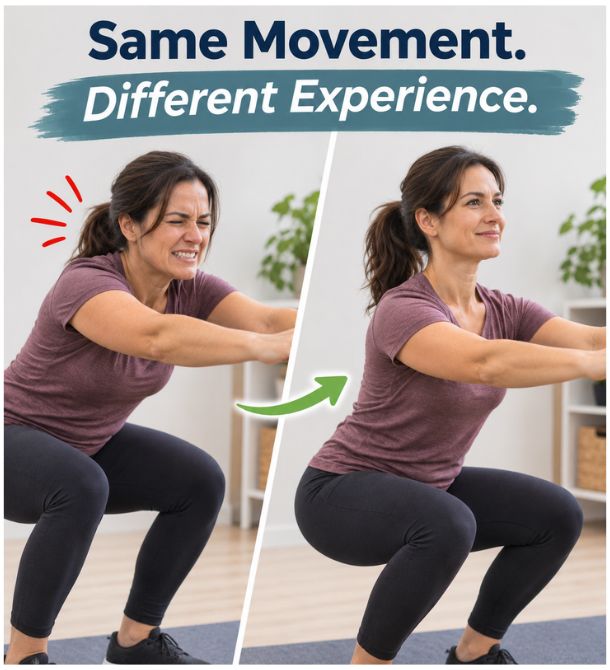
One approach might involve moving quickly, pushing through an uncomfortable range, or continuing long after your body has started telling you the activity is becoming difficult to manage.
Another approach might involve adjusting the depth, slowing the pace, or choosing a level of challenge that feels more manageable.
It’s still a squat.
But the experience may be quite different.
The same applies to stretching, strengthening exercises, and even ordinary activities like getting up from a chair or bending down.
Sometimes changing how we approach a movement can change how it feels.
And those differences matter.
3. Why Stretching More Isn’t Always the Answer
When you feel tight, the natural response is often to stretch.
And stretching can absolutely be helpful.
But what happens if stretching itself feels unpleasant?
Maybe you push into a range that feels uncomfortable because you believe you need to stretch farther to get results.
Or perhaps you keep repeating an exercise that leaves you feeling more irritated afterward.
In those situations, doing more of the same may not be the most helpful approach.
It may be worth changing the intensity, range, duration, or type of movement.
The goal isn’t to avoid every uncomfortable sensation. It’s to find an appropriate level of movement that helps you make progress without repeatedly creating experiences that discourage you from continuing.
This is particularly important if you’ve started associating exercise with feeling worse afterward.
4. A Different Way to Begin Moving Again
If you’ve been feeling increasingly tight, stiff, or reluctant to exercise, you don’t necessarily need to begin with a harder workout or a longer stretching routine.
You might start by exploring how different approaches to movement feel.
For example:
- What happens when you reduce the range of an exercise?
- Does changing the speed make the movement feel more manageable?
- Can you choose a version of the movement that allows you to participate comfortably while still providing an appropriate challenge?
- How do you feel during the activity and afterward?
You don’t need to find a perfectly comfortable movement every time.
Building strength and improving physical capacity often involves effort and gradually increasing challenges.
But finding an appropriate starting point can help you develop more positive movement experiences and greater confidence in what your body can do.
Over time, that can make it easier to return to activities consistently.
And consistency matters when you’re trying to improve strength, mobility, and physical fitness.
5. What If Movement Could Feel Different?
If you’ve been feeling increasingly tense, stiff, or reluctant to move, you don’t necessarily need to start by stretching more or pushing yourself through another workout.
Sometimes, changing how you approach familiar movements can make them feel more manageable and comfortable.
And when movement begins to feel better, you may find yourself more willing to do it again.
That’s what we’d like to help you explore.
Try the Free 3-Day BodyReset
We’ve created a short, guided movement experience to help you discover how changing the way you move can change how it feels.
Over three days, you’ll explore:
- How familiar movements and exercises can feel different depending on your approach.
- Simple adjustments to pace, range, and effort that may make movement more comfortable.
- How to begin applying what you discover to everyday activities.
You don’t need to be in great shape or push yourself harder to begin.
Just bring a little curiosity and a willingness to try something different.

Free access. No credit card required. Start from home at your own pace.






0 comments