

Exercising but Not Getting the Results You Want? Here’s Something You May Be Overlooking
Why the way you approach exercise can matter just as much as the exercises you choose.
You’ve been trying to do the right things.
Maybe you’ve started walking regularly, doing strengthening exercises, stretching more often, or following a workout routine.
You know staying active is important, especially as you get older.
But there’s something frustrating.
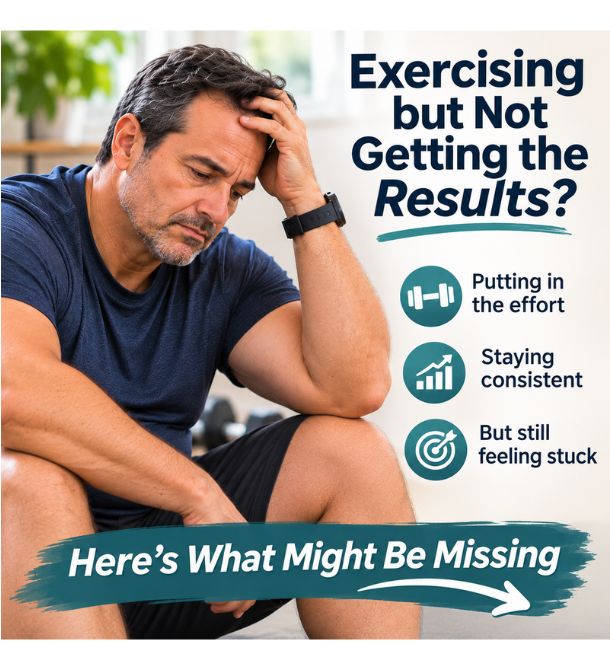
You’re putting in the effort, yet you’re not feeling the improvements you expected.
Maybe you’re still just as stiff as before. Your strength doesn’t seem to be improving much. Or you finish your workouts feeling so uncomfortable or exhausted that you don’t particularly look forward to the next one.
You start wondering:
Am I doing the wrong exercises? Do I need to work harder? Is this just what happens as I get older?
Those are understandable questions.
But there’s another question worth considering.
What if it’s not only which exercises you’re doing, but how you’re approaching them?
1. Doing More Exercise Doesn’t Always Mean Getting Better Results
When exercise isn’t producing the results we want, our first instinct is often to do more.
More repetitions. Longer workouts. Deeper stretches. Heavier weights.
And sometimes, increasing the challenge is exactly what’s needed to make progress.
But not always.
Exercise works best when the challenge is appropriate for your current abilities, goals, and capacity to recover.
Too little challenge may not provide enough stimulus for improvement.
Too much, too soon, may leave you excessively sore, fatigued, or reluctant to repeat the activity.
And sometimes, even a perfectly reasonable exercise can become an unpleasant experience because of how we’re approaching it.
For example, imagine doing a set of squats.
You’re focused on completing 15 repetitions because that’s what your exercise program says.
As you become tired, you start rushing through the movements. You may hold your breath, tighten your whole body, or push into a range that feels increasingly uncomfortable.
You’re no longer thinking about how you’re moving.
You’re just trying to finish.
You may complete all 15 repetitions.
But here’s a question worth asking:
Was finishing the set the only thing that mattered?
2. Your Experience During Exercise Matters, Too
Exercise isn’t just about completing movements.
It’s also an experience your body and brain respond to.
Think about two different workouts.
After the first, you feel challenged but capable. You notice that you’ve worked your muscles, and you feel reasonably confident about doing it again.
After the second, you feel overwhelmed, uncomfortable, or worried that you’ve aggravated something.
Which workout are you more likely to look forward to repeating?
For many people, it’s the first.
That’s because our experiences can influence how we feel about participating in an activity again.
When exercise repeatedly becomes associated with unpleasant experiences, we may begin approaching it with apprehension.
We might start postponing workouts, shortening sessions, or avoiding certain exercises.
Eventually, we may stop altogether.
This doesn’t mean challenging exercise is bad.
In fact, building strength, endurance, and physical capacity requires appropriate effort.
But the way we experience that effort can influence whether we continue exercising consistently enough to benefit from it.
And consistency is an important part of making progress.
3. The Same Exercise Can Feel Very Different
Here’s something interesting.
Two people can perform the same exercise and have very different experiences.
Even the same person can experience an exercise differently depending on how they approach it.
Let’s use squats again.
Imagine your goal is to strengthen your legs.
You could approach the exercise by trying to complete as many repetitions as possible, moving quickly, and pushing through increasing discomfort just to finish.
Or you could begin with a range of movement and level of resistance that matches your current ability.
You could adjust your pace, allow comfortable breathing, and pay attention to how you’re responding as the exercise becomes more challenging.
Both approaches involve movement.
But they may produce very different experiences.
One may leave you feeling discouraged or apprehensive.
The other may help you feel challenged, capable, and more willing to continue.
And as your strength and confidence improve, you can gradually increase the difficulty.
The goal isn’t to make every exercise easy. It’s to find an appropriate challenge that helps you improve and keeps you coming back.
4. When Exercise Starts Feeling Like Something You Have to Get Through
Have you ever noticed yourself watching the clock during a workout?
Counting down the repetitions?
Thinking, I just need to get this over with?
There’s nothing unusual about that. Even people who enjoy exercise have days when they don’t feel particularly motivated.
But if every workout becomes something you dread, it may be worth looking at why.
Maybe the routine is too demanding for your current fitness level.
Maybe you’re not allowing enough recovery between sessions.
Maybe you’re repeatedly choosing movements that aggravate an existing problem.
Or perhaps you’ve become so focused on completing the workout that you haven’t considered whether there’s a more manageable way to approach it.
Whatever the reason, repeatedly having unpleasant exercise experiences can make it harder to stay consistent.
And when consistency suffers, results often suffer too.
This can create a frustrating cycle:
You exercise because you want to feel better.
Exercise repeatedly feels unpleasant or unrewarding.
You begin doing less of it.
Then you feel frustrated because you’re not improving.
Sometimes the solution isn’t more discipline. It’s finding a better approach.
5. Before you do more exercise, try approaching it differently
If you’ve been exercising consistently but aren’t seeing or feeling the improvements you hoped for, your first instinct may be to do more.
More repetitions. Longer workouts. Harder exercises.
But sometimes, it’s worth exploring how you’re approaching the exercises you’re already doing.
The pace, range of movement, level of challenge, and how you respond during an exercise can all influence the experience.
Finding a more manageable approach doesn’t mean avoiding effort. Building strength and improving fitness still require appropriate challenges and progression.
It means learning to use movement in a way that supports your goals and encourages you to keep going.
Try the Free 3-Day BodyReset
We’ve created a short, guided movement experience to help you explore a different approach to familiar movements and exercises.
Over three days, you’ll discover:
- How the same exercise can feel different depending on how you perform it.
- How to explore adjustments to pace, range, and challenge without assuming harder is always better.
- How to begin applying these ideas to your regular movement and exercise routine.
You don’t need a whole new workout routine to begin exploring this.
Start with the movements you’re already familiar with and see what you notice.

Free access. No credit card required. Start from home at your own pace.






0 comments